Showing posts with label holocaust double standard. Show all posts

Tuesday, January 28, 2014

By Michael Hoffman

On Sunday, January 26, the New York Times published a front page story about a book consisting of the single word "Jew" printed six million times as a memorial to "The Holocaust."

Two days later, on January 28, on p. A10 the paper published a story: "A Vast Toll Away From Nazi Death Camps" in which, the Times claims, "Historians are shedding light on the huge numbers of Jews killed in what some call a Holocaust by bullets.”

When Ariel Sharon, the Israeli Butcher of Beirut, died on January 11, the New York Times  in its January 12 edition (p. A12), devoted less than one sentence to  Sharon's mass murder of civilians in Beirut in 1982: "...the Israeli invasion seemed not to end but to take on an increasingly punishing nature, including the saturation bombing of Beirut neighborhoods..."

That is all the Times had to say about Sharon's terror bombing of a major Arab city for several weeks in the summer of 1982.

We see an approved form of holocaust denial when the victims are Arabs and the war crimes are committed by "the Jewish state" less than 34 years ago.

And we see daily and weekly newspaper, radio and television reports, essays, books, lectures and movies about crimes said to have been committed by Germans 70 years ago.

It is our duty to a light a candle in this darkness and ensure that the forbidden knowledge of what the Allies perpetrated against German civilians they considered sub-human during and after World War II, and what "the Jewish state of Israel" has perpetrated against the Arab civilians they regard as sub-human now, is kept alive and known to our children and to history,  just as the monks kept the repository of the collective knowledge of western civilization in remote monasteries, while the barbarian hordes swept Europe —  even as the Zionist-contolled media endeavor to sweep our minds and souls of the last vestiges of that civilization.

***

Wednesday, December 11, 2013

By Michael Hoffman


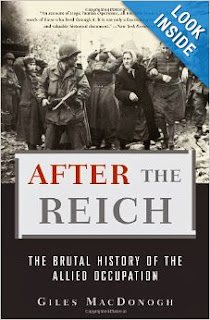
From a review of the book After the Reich: The Brutal History of the Allied Occupation (2009) by Giles MacDonogh:

"This absorbing study of the Allied occupation of Germany and Austria from 1945 to 1949 shows that the end of WWII by no means ended the suffering. A vengeful Red Army visited on German women an ordeal of mass rape, while looting the Soviet occupation zone of almost everything of value, from watches to factories. Millions of ethnic Germans were driven from Poland and Czechoslovakia, stripped of their possessions and subjected to atrocities on the way...Nor were the Germans, with their own death camps finally coming to the world's appalled attention, in a good position to complain...”
 --Publisher's Weekly

If the foregoing reasoning is valid, why were Judaics and Zionists "in a good position to complain" about the so-called "Holocaust," since it occurred in the wake of the Judeo-Bolshevik instigated deaths of millions of Christian gentiles in the Soviet Union?

 Fortunately Publisher's Weekly is wrong. The civilians of a population captive to Nazi or Soviet dictatorship are not collectivly responsible or guilty of any crime and their murders cannot be justified by any civilized criteria.

Nonetheless, the mass murder of German civilians during and immediately after World War II is often justified by the claim that these women, children and elderly men were collectively guilty and deserved to be killed, yet few would dare to apply this same standard to millions of Judaic persons in Eastern Europe and Russia who were ruled by or allied with the Judaic Bolsheviks who slaughtered gentiles, which led to a desire for reprisal on the part of the Germans. The Judaic complaining about this German reprisal has never ceased, and the complaintants appear to be in a very "good position" indeed. Why the double standard?

For further reading:


Princeton University Prof. Arno Mayer, Why Did the Heavens Not Darken? (Pantheon, 1988)

***

Thursday, September 19, 2013

By Michael Hoffman
www.revisionisthistory.org

In an interview filled with what we can only term theological gobbledegook with nary a reference to the Bible, but loads of mystical vertiginous malarkey, Francis the pope of Rome has come out with unprecedented cold-hearted malice toward defenseless, unborn children.

Let us anticipate the response of his defenders and rejoin in advance: no, the pope was not quoted out of context, or misquoted. We’re going to give you his quote in context; and it is said he was handed a copy of his interview and allowed to check and edit it before its publication in the Jesuit magazine, America.

Here are the pontiff’s documented words, in context. First on homosexuality:

We need to proclaim the Gospel on every street corner,” the pope says, “preaching the good news of the kingdom and healing, even with our preaching, every kind of disease and wound. In Buenos Aires I used to receive letters from homosexual persons who are ‘socially wounded’ because they tell me that they feel like the church has always condemned them. But the church does not want to do this. During the return flight from Rio de Janeiro I said that if a homosexual person is of good will and is in search of God, I am no one to judge. By saying this, I said what the catechism says. Religion has the right to express its opinion in the service of the people, but God in creation has set us free: it is not possible to interfere spiritually in the life of a person.  

“A person once asked me, in a provocative manner, if I approved of homosexuality. I replied with another question: ‘Tell me: when God looks at a gay person, does he endorse the existence of this person with love, or reject and condemn this person?’ We must always consider the person. Here we enter into the mystery of the human being. In life, God accompanies persons, and we must accompany them, starting from their situation. It is necessary to accompany them with mercy. When that happens, the Holy Spirit inspires the priest to say the right thing.” (End quote).

Where in the catechism does it say the pontiff has no right to judge a homosexual?

What is this pope babbling about when he says, “...it is not possible to interfere spiritually in the life of a person”?

Furthermore, what is “gay” about sodomy? If God, as the pope claims, “endorses the existence” of a person who practices sodomy, how could God ever send that person to hell?

Nowhere does the pope mention a little something known as sin. He offers no reasons for the sodomite to stop sodomizing. After all, God Himself “endorses the existence” of the sodomite. So why not continue in one’s sins? What is the impetus for change?

The pontiff’s documented words, in context, on abortion and contraception:

"We cannot insist only on issues related to abortion, gay marriage and the use of contraceptive methods. This is not possible. I have not spoken much about these things, and I was reprimanded for that. But when we speak about these issues, we have to talk about them in a context. The teaching of the church, for that matter, is clear and I am a son of the church, but it is not necessary to talk about these issues all the time...The church’s pastoral ministry cannot be obsessed with the transmission of a disjointed multitude of doctrines to be imposed insistently...We have to find a new balance; otherwise even the moral edifice of the church is likely to fall like a house of cards, losing the freshness and fragrance of the Gospel.”  (End quote).

Perhaps someone should tell the pope it is not necessary for the post-Vatican II Church to insist only on issues related to the Nazi “Holocaust," anti-semitism and the defense of Talmudic Judaism as possessing an unbroken covenant with God. "We have to find a new balance." Does the pope agree? Would he be caught dead saying that the pastoral ministry cannot be “obsessed” with the Nazi “Holocaust”?

We don't believe, short of a divine miracle, Francis would ever make such a statement, for unlike the dehumanized and marginalized unborn children awaiting the executioner's invasion of their mother's womb, the Nazi "Holocaust" lobby has enormous power on earth. The victims of the abortion holocaust have no such lobby with comparable power on earth.

Let us also not forget that this coffin-rider who calls himself pope is declaring that too much has been said against birth control (contraception). The people who brought the Gospel to the world, who inhabit the nations of Britain, Ireland, Europe, Canada, Australia and the United States, are self-extinguishing due to contraception being winked at by their religious leaders — and now it is minimized by the pope himself. This is incredible. It is totally revolutionary. Even the pope of Vatican II, Paul VI, devoted himself to composing the encyclical Humane Vitae, closing the door forever on artificial contraception. But Francis declares, "We have to find a new balance.” Between what, life and death? (Rev. 3:15).

According to fake prophecies cooked up during the Renaissance and attributed to the medieval St. Malachy, the current Pope Francis is the last pontiff, dubbed, in that phony prophecy, “Peter Romanus.”

We propose a new name for him, Diabolus Romanus.

Hoffman is the author of Usury in Christendom: The Mortal Sin that Was and Now is Not.

***

Tuesday, November 8, 2011

Editor's Note: The insouciance with which the New York Times celebrates the life of the late atomic physicist Norman Ramsey, who died Nov. 4, is breathtaking. Accompanying their obituary (below), The Times published a photo of Ramsey signing the atomic bomb that was dropped on Nagasaki and killed tens of thousands of civilians, as if he were signing a birthday card. If Dr. Ramsey had been photographed signing the door of the alleged gas chamber at Auschwitz, the New York Times would have condemned him as a monster, but their laudatory obituary is oblivious to the horrors perpetrated at Nagasaki by war criminals like Ramsey, including Japanese children with acute radiation burns. This depraved indifference emanates from blind faith in the Allied dogma of The Good War, and the Talmudic mentality of Judaic-victim exceptionalism. 
                             
Norman Ramsey Dies at 96; Work Led to the Atomic Clock
By Jascha Hoffman
New York Times, November 7, 2011, page A19

Norman F. Ramsey in 1989

Ramsey signing the atomic bomb that was dropped on Nagasaki, Japan in 1945.

Norman F. Ramsey, the Nobel Prize-winning physicist who developed a precise method to probe the structure of atoms and molecules and used it to devise a remarkably exact way to keep time, died on Friday in Wayland, Mass. He was 96. His death was confirmed by his wife, Ellie. In 1949, Dr. Ramsey invented an experimental technique to measure the frequencies of electromagnetic radiation most readily absorbed by atoms and molecules. The technique allowed scientists to investigate their structure with greater accuracy and enabled the development of a new kind of timekeeping device known as the atomic clock. Dr. Ramsey received the Nobel Prize in Physics in 1989 for both achievements.

“If you made a list of the most outstanding physicists of the 20th century, he’d be among the leaders,” said Leon M. Lederman, emeritus director of the Fermi National Accelerator Laboratory in Batavia, Ill., which Dr. Ramsey helped found.

Early in the 20th century, physicists began to decipher the structure of atoms from measurements of the wavelengths of light they released and absorbed, a method called atomic spectroscopy. In 1937, the physicist Isidor Isaac Rabi of Columbia University developed a means of studying atoms and molecules by sending a stream of them through rapidly alternating magnetic fields. As Dr. Rabi’s student at Columbia in the late 1930s, Dr. Ramsey worked to refine it.

In 1949, when he was at Harvard, Dr. Ramsey discovered a way to improve the technique’s accuracy: exposing the atoms and molecules to the magnetic fields only briefly as they entered and left the apparatus. His new approach — which Dr. Ramsey called the separated oscillatory fields method, but which is often simply referred to as the Ramsey method — is widely used today. Dr. Ramsey’s research helped lay the groundwork for nuclear magnetic resonance, whose applications include the M.R.I. technique now widely used for medical diagnosis. (Do his MRIs help diagnose elderly Japanese with radiation sickness from Nagasaki? -Michael Hoffman)

But the most immediate application of the Ramsey method has been in the development of highly accurate atomic clocks. Since 1967 it has been used to define the exact span of a second, not as a fraction of the time it takes Earth to revolve around the Sun, but as 9,192,631,770 radiation cycles of a cesium atom. In 1960, working with his student Daniel Kleppner, now an emeritus professor of physics at the Massachusetts Institute of Technology, Dr. Ramsey invented a different type of atomic clock, known as the hydrogen maser, whose remarkable stability has since been used to confirm the minute effects of gravity on time as predicted by Einstein’s theory of general relativity. Atomic clocks like the hydrogen maser are also used in the ground-based timing systems that track global positioning satellites. Dr. Ramsey did not anticipate that his laboratory technique would have such applications. “I didn’t even know there was a problem about clocks initially,” he said in a 1995 oral history interview. “My wristwatch was pretty good.”

Norman Foster Ramsey Jr. was born on Aug. 27, 1915, in Washington, the son of Minna Bauer Ramsey, a mathematics teacher, and Norman Foster Ramsey, an Army officer. After receiving his Ph.D. under Dr. Rabi at Columbia, he worked at the M.I.T. Radiation Laboratory and served as a radar consultant to the secretary of war.

In 1943 he went to Los Alamos, N.M., to work on the Manhattan Project, leading a team that helped assemble the bombs dropped on Hiroshima and Nagasaki, Japan (the Times has no other comment on his role in the atomic holocaust - Michael Hoffman).

After the war, he taught for nearly four decades at Harvard, mentoring scores of graduate students, many of whom went on to start their own research groups. Although he officially retired in 1986, he continued his work through his early 90s. In recent years, he collaborated with a team of British physicists to study the symmetry of the neutron, searching for evidence that it was not perfectly spherical. Dr. Ramsey presided over the founding of Fermilab and another major particle accelerator laboratory, the Brookhaven National Laboratory on Long Island, where he was the first head of the physics department in the 1940s. As the first science adviser to NATO, he initiated summer school programs to train European scientists. He led a National Research Council committee that concluded in 1982 that contrary to the findings of the House Select Committee on Assassinations, acoustical evidence did not support the existence of a second gunman in the assassination of President John F. Kennedy.

Dr. Ramsey had an athletic flair. He learned to ski in Norway in the 1930s. Later, he took up long-board surfing and ice sailing, and he traveled with his second wife, Ellie Welch Ramsey, from the Himalayas to Antarctica. After having a knee replaced in the 1980s, he continued to ski. Dr. Ramsey’s first wife, Elinor, died in 1983. In addition to his wife, he is survived by four daughters, Margaret Kasschau, Patricia Ramsey, Winifred Swarr and Janet Farrell; two stepchildren, Marguerite and Gerard Welch; eight grandchildren; and nine great-grandchildren.

Colleagues said Dr. Ramsey was a tall man with bright white hair who gestured energetically and walked briskly. “He had a messianic quality when talking about his work,” said Gerald Gabrielse, a physics professor at Harvard. William Phillips, a physicist at the University of Maryland, said Dr. Ramsey’s forceful presence and as his contributions “set the tone for a generation of physicists.”

(Emphasis supplied)

***

Friday, February 18, 2011

Top Genocide Scholars Battle Over How To Characterize Israel’s Actions

Some scholars say that what is now called ‘ethnic cleansing’ constitutes a form of genocide

By Gal Beckerman | Forward | February 16, 2011

Did Jews commit genocide in 1948? The question is provocative, and the answer for most people is an unequivocal no. But a debate over this idea has formed the crux of a heated argument among the most eminent genocide scholars in the world, and led recently to the censure of an Israeli professor by the field’s leading academic association.

It’s also one more reminder of the growing divide between European scholars and their American and Israeli counterparts when it comes to how they view Israel, both historically and in the present moment.

The debate began in the pages of a scholarly publication, the Winter 2010 issue of the Journal of Genocide Research. Two specialists in genocide, Omer Bartov of Brown University and Martin Shaw of Roehampton University, in London, engaged in a back-and-forth exchange about whether the word “genocide” could be applied to the expulsion and killing of Arabs in Palestine during Israel’s War of Independence. During the course of the war, more than 700,000 Palestinians fled or were forced out of their homes and were later prevented from returning, creating what would become one of the world’s most enduring refugee crises.

Both Bartov and Shaw agreed that some form of what is now called “ethnic cleansing” did occur. But where Bartov was not willing to think of this as genocide, Shaw confidently argued that any policies meant to destroy a group, even if not outright murder, should be seen as genocide. With this more expansive reading, he sees genocide victims everywhere, from the Aborigines in Australia to the Albanians uprooted from Kosovo. And Shaw goes further, claiming that the entire Zionist enterprise had “an incipiently genocidal mentality” toward the Arabs. Due to what he views as Israel’s original sin, Shaw argues that the state’s policies toward Palestinians and its Arab citizens since “can be seen as a ‘slow-motion’ extension and consolidation of the genocide of 1948.”

In the exchange, Bartov described Shaw’s ultimate purpose as “delegitimizing” Israel, and offered plenty of evidence for why calling what Jews did in 1948 “genocide” would only serve to render the term “meaningless.”

But it didn’t end there. Israel Charny, an American-born scholar who immigrated to Israel and who directs the Institute on the Holocaust and Genocide in Jerusalem and edited the Encyclopedia of Genocide, was offended by the exchange. He wrote a response that was posted on the discussion board of the International Association of Genocide Scholars (IAGS), a 16-year-old organization that is considered the pre-eminent association of its kind. Charny did not mince words. He referred to Shaw’s argument as the “delusional projection of an angry soul,” and accused Shaw of attacks on Israel and Zionism that were “blind and rampaging.”

Shaw complained that Charny’s criticism amounted to an ad hominem assault, and the president of IAGS, William Schabas, apologized to Shaw, admitting that the offending message shouldn’t have been posted. Schabas then took the unprecedented step of formally censuring Charny.

“My only concern is that we have a debate in which the tone is between civilized academics, discussing things in an appropriate way,” Schabas, a professor of international law at the National University of Ireland in Galway, told the Forward. “Charny’s comments were too intemperate. So we apologized to Shaw and let the debate continue.”

But to Charny, this was one more sign that a field that was started as “a civilizational response to the horror of the Holocaust” has been turned against the Jewish state. “This is ultimately a story of anti-Semitism and anti-Zionism, including among genocide scholars,” Charny told the Forward.

Charny makes it clear that he does think Jews committed what he calls “genocidal massacres” during the war of 1948, like the infamous shooting of civilians in the village of Deir Yassin, in which more than 100 unarmed people were killed in a brutal raid. But he does not consider the “ethnic cleansing” that took place as constituting genocide, nor does he think, as Shaw contends, that the Zionists had any genocidal objective.

“I do not believe the war was undertaken by us with a genocidal intent at all — it was in self-defense for the establishment of Israel per the U.N. mandate and our cherished Zionist dream,” Charny said. “And I do not at all believe that we had any grand genocidal plan in our warfare or in the collective mind-culture in which the Yishuv [pre-state government] was operating.”

According to the United Nations’ Convention on the Prevention and Punishment of the Crime of Genocide, adopted at the end of 1948, genocide is legally defined as “acts committed with intent to destroy, in whole or in part, a national, ethnical, racial or religious group.” Nowhere does it specifically mention what we would think of today as ethnic cleansing, but there are those scholars, like Shaw, who believe that ethnic cleansing does indeed fall within the convention’s initial meaning.

Shaw thinks Charny’s reaction is indicative of those scholars he calls “pro-Israel,” those who he thinks are incapable of applying the same critical eye to Israel and its past that they do to other peoples’ histories.

“He’s an American Jew who’s gone to Israel, and he has invested a lot of his identity in Israel — whereas criticisms of the recent attack on Gaza don’t necessarily bring the whole existence of the state into question, this seems to him as an argument that strikes at the foundations,” Shaw said, speaking of Charny. “The other issue is that there is a problem with the language of genocide with anything having to do with Jews. For some Israeli and pro-Israeli scholars, genocide is something that happened to the Jews; it’s not something that Jews could ever really be involved in.”

This current conflict between the scholars in some ways cements what was already an ideological rift.
In 2005, a group of genocide researchers, many of whom had been part of IAGS (International Association of Genocide Scholars), decided to start their own rival organization, calling it the International Network of Genocide Scholars. The reason they say they broke away was twofold: They felt that IAGS had become too American in its perspective, and that it had become too politically activist. Unofficially, according to Shaw, the feeling was that the association was “overtly pro-Israel.” Shaw cites the example of a resolution that the association issued in reaction to Iranian President Mahmoud Ahmadinejad’s comments about destroying Israel. The resolution condemned this as a threat of genocide. Shaw did not believe it was the place of genocide scholars to make such a pronouncement.

The two groups have continued independently — though they share many of the same members — until this past year, when there was talk of a merger, initiated by Schabas. Recently, after a few meetings to negotiate what would have been a new organization, the INoGS leadership said it was no longer interested. Schabas thinks the timing was not coincidental.

“If you would ask them who would be representative of the things they don’t like in the association, probably Israel Charny would be at the top of the list,” Schabas said. “I suspect that the recent explosion between Charny and Shaw may have contributed to the fact that the discussions about merging the two associations have melted down.”

INoGS is led by Juergen Zimmerer, a professor at the University of Sheffield, in the United Kingdon. Zimmerer said that the decision not to merge had nothing to do with the flare-up between the two scholars. “We simply felt that IAGS was too divided internally to proceed with the merger at the moment,” Zimmerer wrote in an e-mail to the Forward.

According to Charny, the crux of the problem is the issue of Israel. In a reversal of the criticism that the breakaway INoGS scholars had of IAGS, he thinks that hatred of the Jewish state has undermined their scholarship“While saying that they don’t take any political position, they are slowly but surely, insidiously, under a smokescreen of their good English manners and their supposedly dispassionate point of view, becoming a hotbed of anti-Israel, anti-Jewish sentiment, which they will of course deny vociferously,” Charny said.

For now, the two organizations seem to remain deeply divided. Schabas, who is nearing the end of his tenure, looked back at the volatility of presiding over an association of genocide scholars.
“It’s like riding a bucking bronco,” he said. (End quote; emphasis supplied)

Contact reporter Gal Beckerman at beckerman@forward.com or on Twitter @galbeckerman


***